Core Frameworks
Framework #1: Lead Magnet Framework
{{first_name}} - created a Lead Magnet for {{company_name}} covering the {Mechanism Strategy} we implemented to help {{Client from same Industry}}, {Client Name}, generate {{Result}} within the last {{Timeframe}} - {{CTA}}?
When to use: When you have a valuable resource and strong case study from their industry.
Framework #2: Free Work/Frontend Offer (One-Sentence Email)
{{first_name}} - interested in {{Free Work/Frontend Offer}} for {{company_name}}?

%signature%

P.S. {{Social proof}}
Note: This is literally the full email—one sentence + P.S. line.
When to use: When you have a low-barrier offer that speaks for itself.
Framework #3: Dream Result Guarantee Framework
{{first_name}} - interested in generating {{Dream Result}} with {{Mechanism}} for {{company_name}} in the next {{Timeframe}}?

Asking since our {{Mechanism}} guarantees {{Dream Result}} in {{Timeframe}} for your company or {{Risk Reversal}} - {{CTA}}?
Note: Can offer a lead magnet for the CTA as well.
When to use: When you have strong guarantees and can confidently promise outcomes.
Framework #4: Pain Point Question Framework
{{first_name}} - {{Relevant question around pain point}}?

Our {solution} offers {how to fix problem} to {{achieve end result of solution}}

{Interest-based CTA}

%signature%

P.S. {{Social proof}}
When to use: When you want to lead with curiosity and problem awareness.
Josh Braun’s 4-Sentence Formula
Sentence 1: Show you did your homework
“I noticed on your website that xyz is a customer. Congrats on getting traction with such an established brand, which is undeniably no small feat for an early stage startup.”
Sentence 2: Explain what they are missing out on
“I know from speaking with other founders that many, if not all, find it challenging to developing a repeatable selling process in a way that feels natural, comfortable, and authentic without sounding “sales-y.” The impact – inaction. Lack of a predictable pipeline and sales.”
Sentence 3: Explain how you might be able to help and add social proof
“In the past year we’ve worked with companies like abc and def to help them close more deals in less time without selling their soul, and we think we might be able to help xyz in this area as well.”
Sentence 4: Include a call to action
“I’m not sure if this is a fit for you folks, but if you’d like to learn more, would you be open to carving out some time to explore?”
Sentence 4 Variation:
“If you’d like, I can send you a 2 minute demo so you can evaluate.”
When to use: For thoughtful, consultative outreach to executives and founders.
Quick Question Template
Subject: [2-3 boring words]

{Pain point}

Same case for {company}?

Best,
[Name]

PS - [personalized line based on research]
Example:
I talked to a few other $10m/year CSOs and many of them are struggling to qualify and score their leads.
Same case for Salesforce?
Best, Bergen
PS - saw your Linkedin post about hiring for CS, how’s the search going?
Follow-Up:
The reason I ask is we’ve been {{helping similar companies achieve result}}, and {{want to do the same for you, with risk reversal}}.
Can I send a 5-minute Loom explaining how?
When to use: Short, punchy opener for busy executives.
Observation → Curiosity → Soft CTA → PS Structure
Subject: [2-4 words]

Hey [Name],

1. Observation / Pain described
2. Curiosity / Pain agitation
3. Soft CTA
4. PS
Example:
Subject: ramp up stress
Hey Robert - long ramp-up processes generate stress and don’t ensure the sales rep is ready to be a top performer.
This is usually because the ramp-up focuses on the product, not your prospects. With <29% reps hitting quota, having a good ramp-up process is key.
Can I share how I helped [competitor] shift their approach, helping their reps ramp in half time and hit quota within the first 3 months?
Best
When to use: When you have specific insight about a process problem in their business.
The “What People Hate” Framework
[Name] – What people hate about [current approach] is [specific frustrations that create empty results].

Over [X] companies have used our service to [specific outcome] without [pain points]. We handle everything end-to-end so you can focus on [their priority].

Would you consider [low-friction CTA]?
Example:
Alex – What people hate about outbound is spending hours setting up tools, testing deliverability, and writing emails that don’t land, only to end up with an empty calendar.
Over 100 companies have used our service to book 10+ meetings per month with their ideal customers—without complex tools, email headaches, or spending extra hours managing systems. We handle everything end-to-end so you can focus on closing deals.
Would you consider letting us handle your outreach to add 10 meetings to your pipeline?
When to use: When you can empathize deeply with current solution frustrations.
The “Poke the Bear” Framework
[Genuine compliment about their work]

[Question that challenges their current approach or offers new perspective]

[Social proof or specific example]

[Low-friction CTA]
Example:
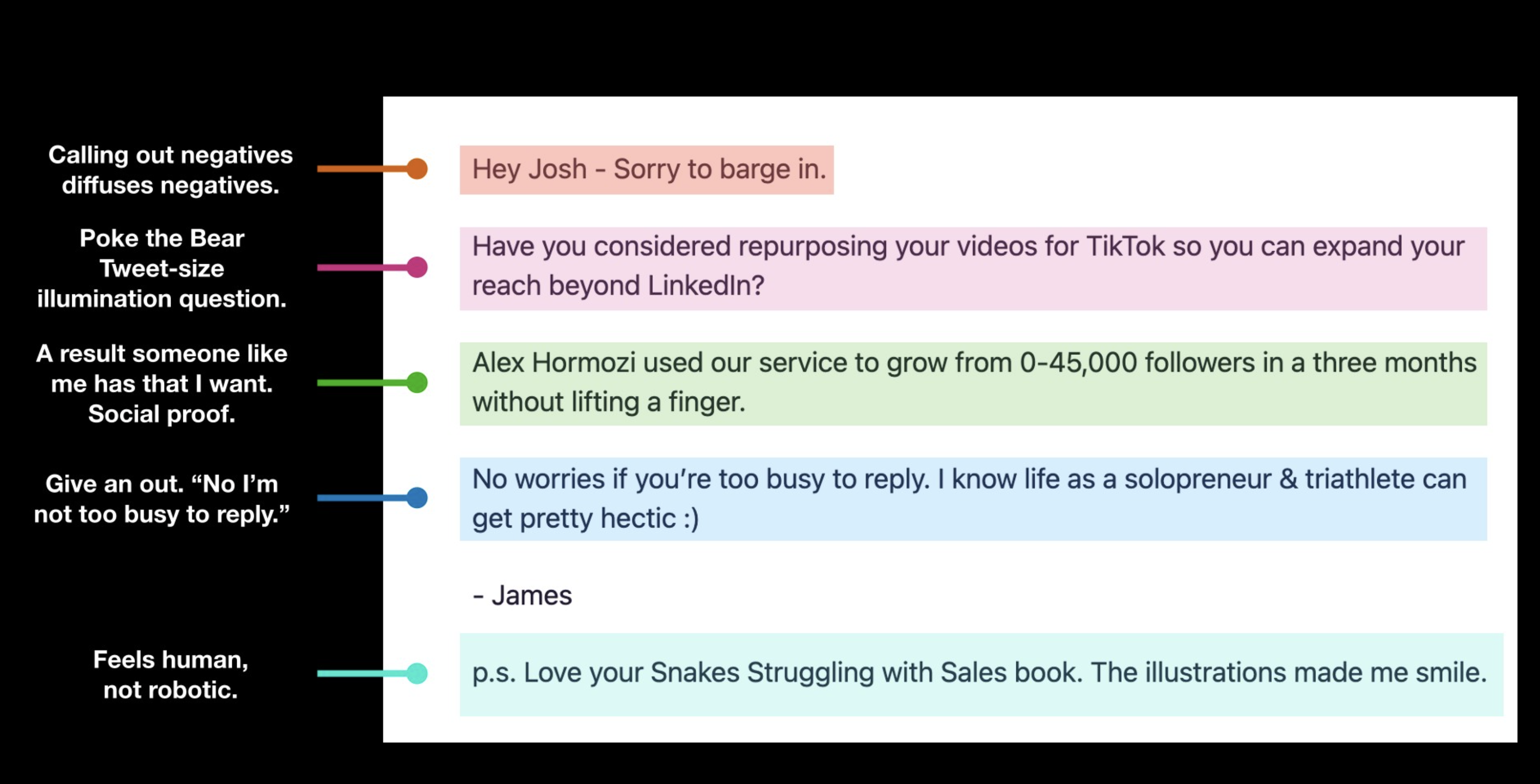
Josh – Your video on sales anxiety was spot on. Enjoyed your two cents on detaching from the outcome. Simple but not easy:-).
Have you considered repurposing your videos for TikTok to expand reach beyond LinkedIn?
@abhormozi grew from 0-23k followers in two months without lifting a finger.
Here’s a demo to show you what it might look like. [link]
Is this something you’d be open to exploring?
When to use: When you have a genuine insight that could help them beyond just your service.
Complete Email Examples
Example 1: Competitive Intelligence Series (Mailshake)
Email 1:
Subject: Mailshake or Outreach??
Hi [Name],
Out of curiosity, how often are you in competitive deals against Outreach?
Tried booking a demo and found I can’t live-chat w/ sales or schedule demos outside business hours with them.
With 35-50% of deals in the sales engagement space going to the first responder, not having this capability results in losing 50%+ of interested prospects to competitors. Opportunity cost = 2x increase in booked demos every month.
I realize this probably isn’t on your radar, but are you open to seeing if there’s a fit?
Talk soon, Kyle
Email 2 (Follow-up):
Looks like you also compete with SalesLoft? A day later and they still haven’t responded to my inbound request.
This means your two biggest competitors (from what I can tell) are completely dropping the ball on engaging right away w/ their highest intent leads.
The gaps I’m seeing in their processes = huge upside for you all.
Not sure if this is for you but I’m happy to take you through our playbook if you’re interested?
Email 3 (Follow-up):
Wow same story again with Reply.io. Don’t understand why, but few in sales engagement are prioritizing immediate engagement w/ high intent visitors.
If they had a team of inbound/online sales reps dedicated to engaging in under 60 seconds 24/7, qualified inbound pipeline would 2-3x right away.
Our team could respond/engage w/ inbound leads for you 24/7 and it’ll give you a huge leg up on Outreach, SalesLoft, and Reply.io.
I can share more next week with you if you’re game?
Why this works: Real-time competitive intelligence. Each email adds value. Shows initiative and provides actionable insights.
Example 2: Jobs-to-be-Done (Cordless MiniSaw)
Subject: 5522 Marbella Drive
Hey Josh – Honestly now did you spend your youth dreaming about someday spending your Sunday afternoon trimming trees on Marbella Drive?
Ten million homeowners use the Cordless Mini Saw to trim five trees in 30 minutes. 6.5 hour charge. No $100 per tree landscaper.
Worth a peek?
Why this works: Emotionally resonant. Uses specific address. Contrasts dream state with reality. Benefit-focused. Easy CTA.
Example 3: AI Analytics Platform (Trubrics)
Version 1: Question Lead
Hi First Name—how are you currently measuring the impact of your AI assistant on user experience and business outcomes?
I noticed that Company is leveraging AI assistants in production, which is great to see.
When we’ve spoken to CPOs we often hear: “We’ve implemented AI into our product, but it’s not generating the business value we expected” or “We struggle to measure the real impact of our AI features”
Our solution at Trubrics offers real-time, AI-powered analytics to track and optimise your AI interactions, helping you identify bottlenecks, improve retention, and drive conversions.
If this resonates with you, would you mind if I share more details?
Version 2: Case Study Lead
Hi First Name,
I wanted to take a closer look at a common challenge we see with AI-driven products—tracking the impact of AI on user engagement and retention.
At Trubrics, we enable product teams to track and optimise AI interactions in real time. Whether it’s identifying bottlenecks in your conversion funnel or pinpointing areas where users are experiencing friction, our platform helps you make data-driven decisions that significantly enhance the value of your AI features.
For instance, one of our FinTech clients saw a 15% increase in user retention within three months after using Trubrics to detect and resolve AI friction points.
Would you mind if I shared a quick demo to show how we can help your team get similar results?
Version 3: Follow-Up with ROI Focus
Hi First Name,
I’ve reached out a couple of times to see if Trubrics might be a fit for your team, and I wanted to ensure I’m addressing your needs effectively. Many teams we work with face a similar challenge—investing in AI but not seeing the clear ROI. Does this sound familiar to your team?
Our AI-powered analytics platform can be integrated within a week, delivering daily insights into your AI’s performance via email or Slack. Our clients have seen improved user retention, greater AI feature adoption, and even discovered new product opportunities by using our analytics.
If this resonates, let’s schedule a quick chat to see if we can unlock similar results for your team.
Looking forward to hearing from you,
Why these work: Specific to persona and pain point. Uses social proof. Multiple approaches for A/B testing.
Example 4: Marketing Automation
Emma, have you thought about automating your email sequences to free up more time for high-value sales conversations?
A few {subindustry} companies I’ve worked with used our system to book 10+ meetings a month without spending hours writing cold emails. Could be worth exploring!
Either way, I love your approach {companyUSP}—I really enjoyed your recent post on building trust through authenticity.
Why this works: Opens with question. Specific outcome. Genuine compliment based on research.
Example 5: Overwhelm Acknowledgment
John, with all the buzz around automating outbound—new tools, GTM Engineers, Clay tables, and the AI SDRs—it’s easy to feel overwhelmed by how to implement it all into your workflow, especially with so much on your plate.
Several companies in {subindustry} rely on us to book 10 extra meetings per month with their ideal customers—without the headache of setting up complex systems or spending hours managing them.
Worth exploring?
Why this works: Empathy first. Acknowledges complexity before offering simplicity.
Example 6: Simple Social Proof
Hey {{first_name}},

Spoke with X and Y on your team.

They mentioned Z was a challenge.

We've helped companies like A and B accomplish C.

Worth a quick chat to learn how?
Why this works: Direct. Shows internal research. Social proof. Easy CTA.
Email Sequence Structures
Standard 4-Touch Sequence
Day 1 - Email #1
Subject Line: 1-3 words, boring, make it look internal

Hey {{first name}},

[relevance / problem hypothesis]

[value prop]

[offer / CTA]

[P.S. social proof]
Day 4 - Email #2 - Reply to Thread
[resource/visual that adds value]
Day 10 - Email #3
Subject Line: [new subject if breaking thread]

Hey {{first name}},

[relevance / problem hypothesis - different angle]

[value prop]

[offer / CTA]

[P.S.]
Day 14 - Email #4 - Reply to Thread
[resource/visual]
Quick Question Sequence
Day 1:
{Pain point observed from similar companies}

Same case for {company}?

P.S. {personalized observation}
Day 4 Follow-up:
The reason I ask is we've been {{helping similar companies achieve result}}, and {{want to do the same for you, with risk reversal}}.

Can I send a 5-minute Loom explaining how?
Cheeky Follow-Ups
Use sparingly and only when it fits your brand:
Follow-up Lines:
- “John, you don’t have to wait three days to reply.”
- “How have you gone so long without responding to me? I’m a delight.”
Sign-offs:
- “Awaiting your fair but stern reply.”
- “Awaiting your profanity-filled response.”
The Self-Aware Follow-Up Sequence
Day 1: Send generic email intentionally
Day 2: Send this
Remember that email we sent you yesterday? No? That’s because it wasn’t personalized at all. It sucked.
[Now send actually personalized, thoughtful email]
Why this works: Pattern interrupt. Self-aware humor. Shows you can do better and are willing to.
Framework Selection Guide
Use this decision tree:
-
Do you have a strong case study from their industry? → Lead Magnet Framework (#1)
-
Do you have a low-barrier, compelling free offer? → Free Work/Frontend Offer (#2)
-
Can you confidently guarantee specific outcomes? → Dream Result Guarantee Framework (#3)
-
Reaching out to busy executives? → Quick Question Template or Josh Braun’s 4-Sentence Formula
-
Do you have unique competitive intelligence? → Competitive Intelligence Series
-
Is their current solution frustrating? → “What People Hate” Framework
-
Do you have an insight beyond your service? → “Poke the Bear” Framework
-
Want to lead with empathy about market complexity? → Overwhelm Acknowledgment Framework
Testing & Optimization
A/B test these variables:
- Subject line length and style
- Hook approach (question vs. observation vs. compliment)
- CTA type (direct vs. soft vs. value-first)
- Length (50 words vs. 100 vs. 150)
- With/without PS line
- Personalization depth
Track these metrics:
- Open rate (subject line effectiveness)
- Reply rate (content effectiveness)
- Positive reply rate (qualification effectiveness)
- Meeting booked rate (CTA effectiveness)
Key Reminders
- Every framework is a starting point—personalize for your voice
- The best framework is the one that feels natural to write
- Test, measure, iterate
- What works for one audience may flop for another
- Authenticity > cleverness
Additional Examples
Origin: Synthesized from Cold Email Best Practice vault Tags: Sales ColdEmail Frameworks Templates Examples Created: 2025-10-17